


Meet the Dealers, Page 3
April 2001This article is part of the Noteworthy News archives.
Don Hill
 A
cultural anthropologist, Don Hill travelled across the country as a student
recording folk musicians. In 1970 discographer Dick Spottswood interested
him in 78s.
A
cultural anthropologist, Don Hill travelled across the country as a student
recording folk musicians. In 1970 discographer Dick Spottswood interested
him in 78s.
Hill is one of a growing group of collectors of ethnic records--non mainstream, folk music recorded by musicians not formally trained.
The music was recorded from around 1900 to 1942 by major labels such as Columbia, as well as by tiny companies.
New York, France, Ireland and southern Poland were the epicenters of recording, he says, but many titles were recorded elsewhere. Chicago was a center for Ukrainian recordings.
Although many recordings were pressed in the thousands, some small market titles such as Finnish recordings were only issued in the low hundreds.
What’s hot at the moment? Klezmer, Cuban and West Indian, says Hill.
We had to ask. Is anyone collecting Desi Arnaz? No, says Hill, but there are some very good Cuban musicians who performed the same music.
Hill notes that ethnic records remain very affordable. Many titles might cost only a few dollars, and even the rarest titles might cost only $200, as opposed to thousands of dollars for rare jazz recordings.
Hill is a professor of anthropology and Africana-Latino studies at the State University of New York --Oneonta.
Don and Bobbie Gfell
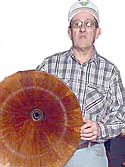 The
retired superintendent of the Berlin-Milan Ohio school district, Don Gfell
remembers that his interest in all things Edison began in 6th grade as
he grew up in Milan, Edison’s home town.
The
retired superintendent of the Berlin-Milan Ohio school district, Don Gfell
remembers that his interest in all things Edison began in 6th grade as
he grew up in Milan, Edison’s home town.
Gfell purchased his first Edison machine about 30 years ago. He collects all sorts of Edisonia such as light bulbs and advertising signs, but among his most treasured memorabilia are some letters that the famous inventor wrote to friends and relatives in his home town.
A few years ago Gfell decided to manufacture wooden horns. Finding the available grades of veneer unsatisfactory, he purchased a fallen 200 year old oak tree from the local cemetary and quarter sawed it himself.
The veneer is steamed and put in a mold to dry, put in a jig to be precision finished, put in another jig to be assembled, and sanded.
How were the horns manufactured originally? “I don’t have any idea,” says Gfell. “My daughter was a researcher at the New York Public Library and she tried for a year to find out.”
Panelled Victor and Columbia horns have been reproduced, as well as smooth music master horns and some original designs. The old oak tree is almost gone.The horns can be seen at the Gfells small antique shop in quaint downtown Milan.
Gfell is also a trustee of the Edison Home in Milan, a national historic site.
Copyright 2017 Vicki Young

Vicki Young
Box 435
Randolph,OH 44265
330 325-7866
 Contact/
We buy, sell, and repair antique phonographs and music boxes.
Pick-up and delivery possible in many parts of the midwest, south, and northeast.
Mechanical music
for sale

Victrolas
Outside horn phonographs
Disc music boxes Swiss cylinder music boxes
Records