


 Resources
Come show your horn. The evolution of the horn on the cylinder phonograph: a concise chronology
April 2002
This article is part of the Noteworthy News archives.
Tin foil horns
Date: from 1877
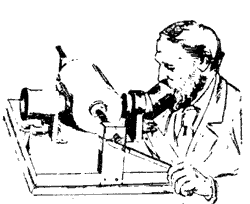
News of Edison's tinfoil
machine was illustrated in the New York Graphic of 1878.
Tin foil horns were typically plain rolled metal. A few looked like crude stovepipes, with no taper. The horn on the Brady machine suggested a telephone mouthpiece.
Listening tubes
Date: obsolete by 1894

An octopus of listening
tubes appears to engulph this Graphophone.(Courtesy Allen
Koenigsberg)
Listening tubes were necessary
because of the faint volume of early brown wax records.
The tubes were made of rubber, with gutta percha earpieces. Deluxe models
were sold with glass earpieces, or telegraphic headphones.
Coin-operated machines equipped with listening rails could accomodate
as many as fourteen customers. Linen napkins were supplied for cleanliness.
Belled horns
Date: around 1897-1906

Brass bell horn with
optional flowers is attributed to Standard Metal Manufacturing.
By 1897 manufacturers had begun
to smooth out the horns and to apply a beaded bell.
Belled or “trumpet” horns were made by companies such as Standard
Metal Manufacturing, the New Jersey Sheet Metal Company, and Hawthorne
and Sheble, which wrapped some of its horns in silk beginning 1905.
Seamless or “sawtooth” horns were higher end merchandise, usually
made of a heavier and better grade of brass.
Glass horns
Date: around 1898-1901
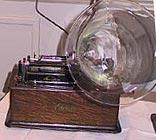
Quality reproductions
of glass horns were offered at the September automated music show.
Always of continental origin, fluted glass horns made in Paris were advertised in the Dec. 1899 Phonoscope.
Petalled horns
Date: beginning 1905
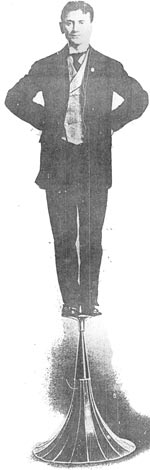
Unidentified gentleman
demonstrates the strength of Standard Metal's Ajax horn for the readers
of Talking Machine World in 1906.
The basic design was probably
invented by Hawthorne and Sheble’s Horace Sheble, who applied for
a patent of a petalled horn in January, 1905.
Petalled horns, referred to in the trade as “flower horns” or
“morning glory horns,” offered lower cost of manufacture than
spun brass, and distributed the sound better for the size. Concave and
convex scallops were seen.
Major manufacturers included Hawthorne and Sheble, Standard Metal Manufacturing,
the Tea Tray Company, and the Searchlight Company, father of a ribbed
horn “constructed on the scientific principle of a searchlight reflector.”
The patent for the familiar Edison morning glory horn was issued to Charles
Eichorn in 1905, who sold the rights to the Tea Tray Company of Newark,
New Jersey, a long established metal working concern. The Tea Tray Company
manufactured Edison’s horns, as well as its own line of aftermarket
amplifiers.
Wooden horns
Date: beginning 1907
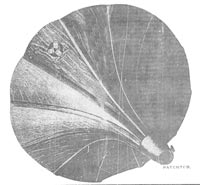
First wooden horn on
the market, the TrueTone horn was touted as rattle and vibration free.
Wooden horns and wood-grained
metal horns of mahogany, golden and flemish oak were introduced in 1907.
The Truetone horn, a petalled wooden horn, was advertised for sale in
1907 for $7.50 with a 23 inch bell. The horn was employed on some Columbia
models.
The seamless wooden horn found on most Edisons and Victors was patented
by Stanislaus Moss in April 1908. The horns were constructed for the industry
by Sheip and Vandergrift, cabinetmakers in Philadelphia long associated
with the trade. A minimum order of 500 horns was required.
Vertical horns
Date: beginning 1907

As on Edison's Cygnet,
the bell could be separated from the elbow of Devineau's Ideal.
Vertical horns saved space
and interpreted with acoustic superiority, although their fidelity was
probably fortuitous and not a result of scientific research.
Edison’s Opera horn of 1911 and his Cygnet horn of 1909 were probably
influenced by the all-aluminum self-supporting Devineau of 1907. The Cygnet
(swan shaped) design was patented in 1908 by Peter Weber, one of Edison’s
in-house inventors.
Copyright 2015 Vicki Young

Vicki Young
Box 435
Randolph,OH 44265
330 325-7866
 Contact/
We buy, sell, and repair antique phonographs and music boxes.
Pick-up and delivery possible in many parts of the midwest, south, and northeast.
Mechanical music
for sale

Victrolas
Outside horn phonographs
Disc music boxes Swiss cylinder music boxes
Records